



Conventional Approach
Requires the running of Wireline or LWD/MWD Gamma Ray, Sonic and Density to derive the most relevant geomechanical parameters: Young’s modulus, UCS, Vp/Vs, density, Poisson’s Ratio, shear and bulk modulus. The cost of running these downhole tools can be high and risky in highly deviated and horizontal wells, limiting the direct determination of the geomechanical parameters in development wells. Although obtaining this data can allow improved decision making in near-real time, this comes at a significant cost and risk.
GEOLOG’s Approach
The same geomechanical parameters are obtained using machine learning technologies to create and train a Model based on available data from a limited number of wells in the same field (typically five). This model allows us to predict with high accuracy the geomechanical parameters in new wells using only drilling parameters and Gamma Ray, eliminating the need to run Sonic and Density tools and their associated costs and risks: enabling improved decision making in near-real time with low-risk, low cost data when you most need it.
GeoMechanics Solution
GEOLOG has developed a proprietary workflow, named GeoMechanics that takes data from different depth-based data sets . The tests performed in different geological contexts have shown that the minimum number of wells for creating and training the Model ranges from 4 to 6 depending on the quality of the data.
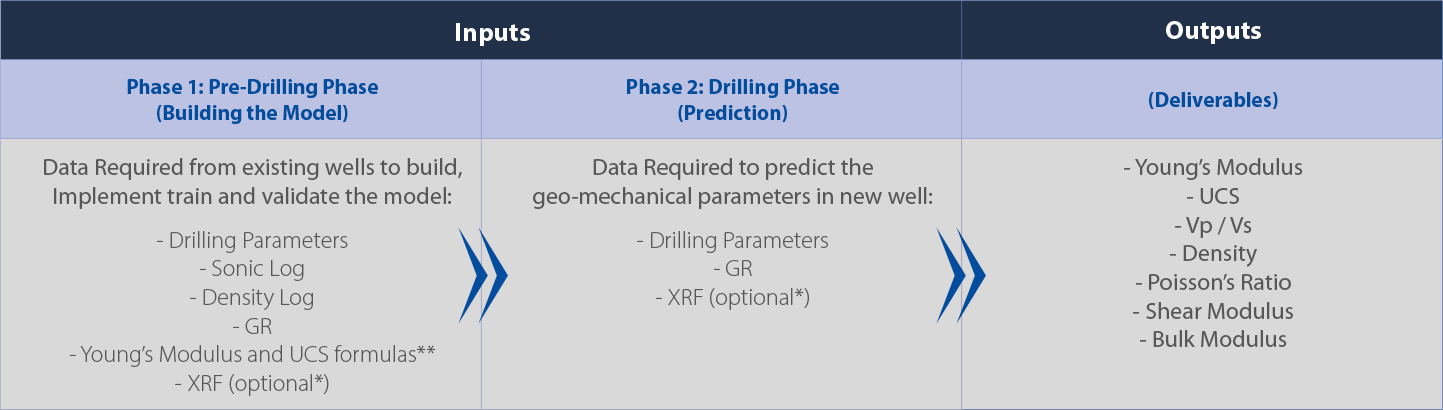
* XRF can replace GR in case of tool failure or data unavailability.
** Young’s Modulus and UCS are calculated from logs using empirical formulas. Client can propose preferred formulas.
Challenges and Solutions
- Perform geomechanical characterization while drilling in different geological contexts (carbonates, unconventional, siliciclastic).
- Sonic and density logs are not required in the new wells to obtain geomechanical parameters.
- Provide an alternative to downhole tools (sonic and density) when their use is risky (Horizontal Wells).
- Possibility to obtain the geomechanical data of existing wells in a given field to optimize future drilling.
Case History
Model Building and Validation – Offset Wells
GeoMechanics was trained with 10 wells in the same basin across carbonate formations. These wells have a full range of petrophysical well logs provided by the client (Density, Sonic and Gamma logs), and the depth-based drilling parameters and the XRF data provided by GEOLOG.
Prediction of GeoMechanical Parameters – New Wells
GeoMechanics requires depth-based drilling parameters provided by GEOLOG and gamma ray (Wireline or LWD or MWD) provided by the client. XRF can replace GR in case of data unavailability or tool failure.
Results: Poisson’s Ratio and Young’s Modulus
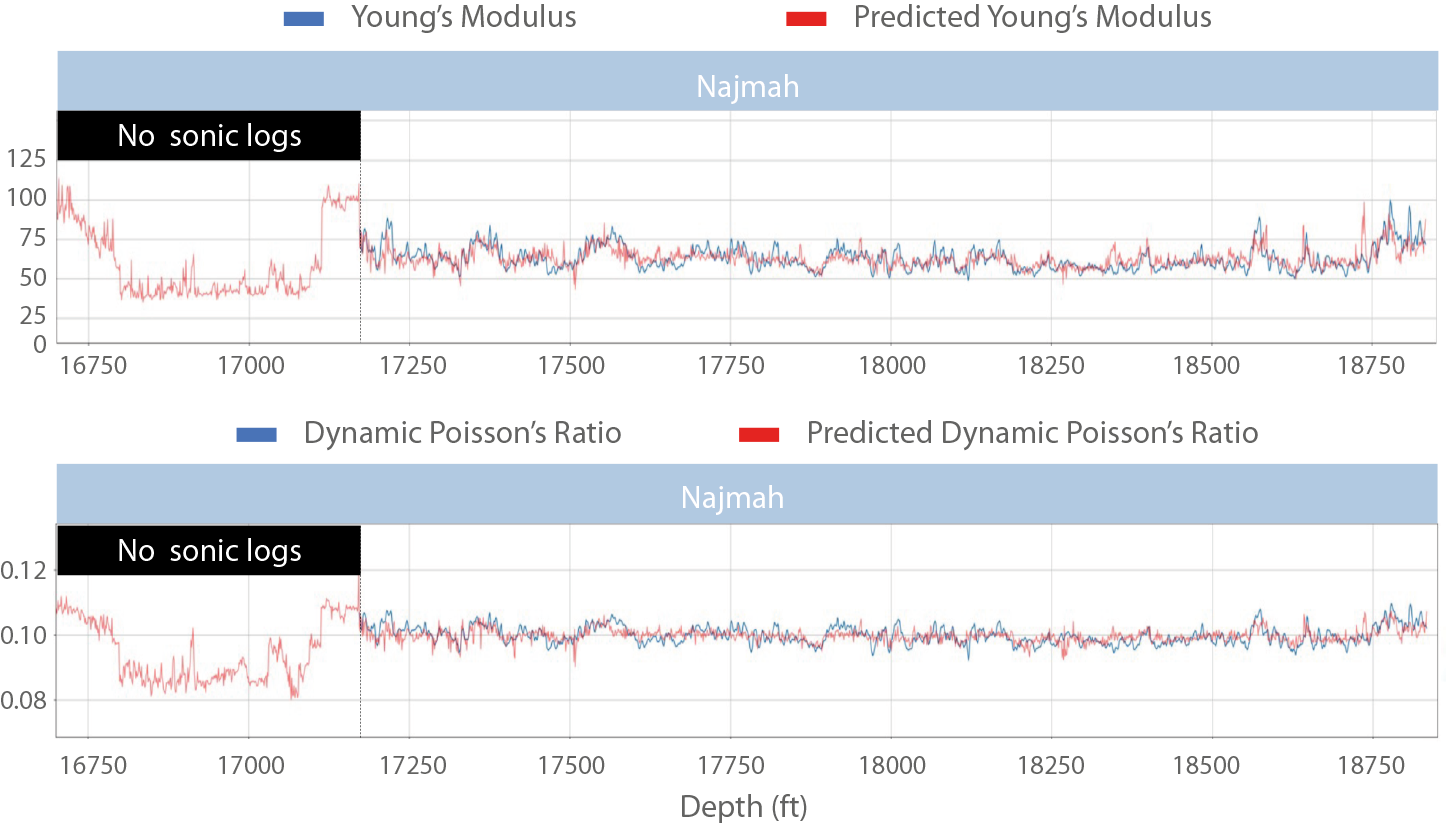
In the graphs the results of GeoMechanics Poisson’s ratio and Young’s Modulus. In blue, the “Conventional approach”, in red, the parameter value predicted by GEOLOG. The derived values were closely aligned with the well-log derived data for the same well with errors consistently within 5% of log values derived by conventional logs.