
RESOURCES

Technical Papers, Brochures, Case Studies

First Break Magazine, GEOLOG

February 2024

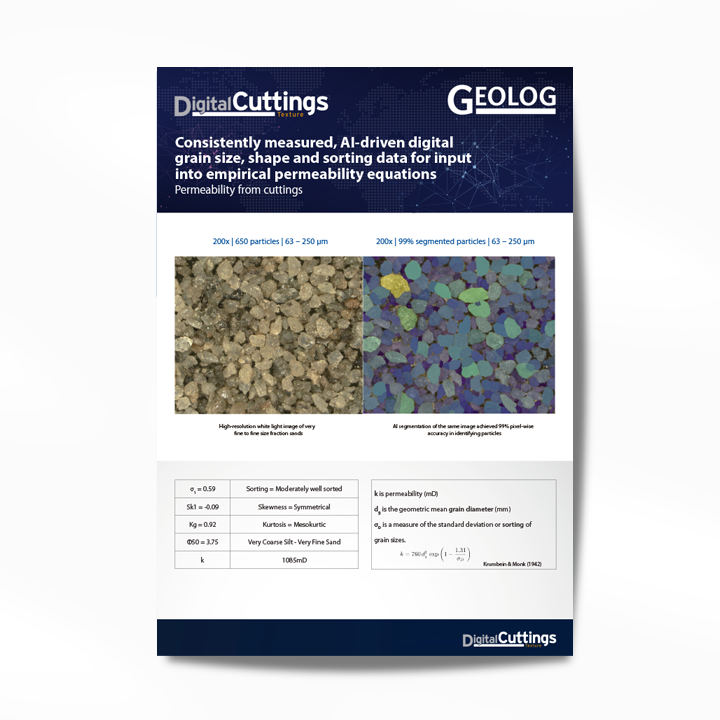
This study analyzed drill cuttings and mud gas data to understand unconventional reservoir parameters. Classifying lithofacies and assessing reservoir rock quality showed that wells with higher-quality reservoirs perform better, highlighting the need to understand spatial reservoir architecture for optimizing production.




Using a Drill Cuttings-based Approach to Predict Reservoir Performance for Improved Well Optimization. A Case Study From the Harkey Mills Sand and 2nd Bone Springs Sand, Bone Spring Formation, Lea County, New Mexico, USA

June 2023, URTeC

This study analysed drill cuttings and mud gas data to understand the reservoir parameters of unconventional plays. By classifying lithofacies and identifying the quality of reservoir rock, it was found that wells with higher-quality reservoirs performed better, emphasising the importance of understanding spatial reservoir architecture for optimising production.


Risk reduction in the derivation of while-drilling wellbore geomechanical properties by utilization of real-time surface logging and gamma ray data through the application of machine learning techniques to pre-existing data sets

June 2023, SPWLA

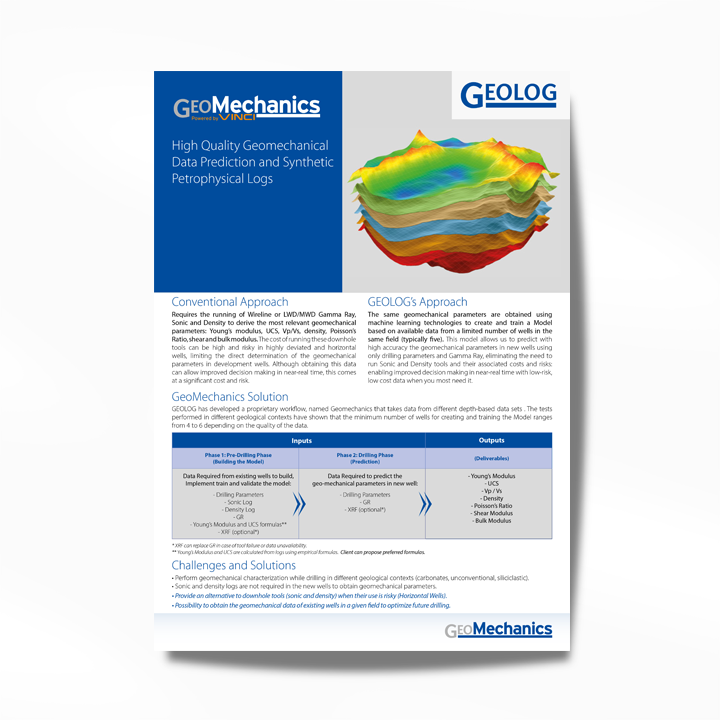
This work presents a reliable method using surface logging data and well log data to evaluate geomechanical parameters. By employing machine learning algorithms and combining drilling parameters with Gamma Ray, Sonic, and Bulk Density logs, the model successfully predicts geomechanical properties in newly drilled wells.


Derivation of rock's geomechanical parameters while drilling by combining surface drilling data, gamma ray data, and machine learning techniques in carbonate formations

February 2023, EAGE First Break

This study develops a robust methodology using drilling and well log data, combined with machine learning, to accurately derive geomechanical parameters from 11 wells in Kuwait. It includes an innovative approach—creating a Synthetic Gamma Ray from XRF analysis—to expand its applicability in scenarios where traditional downhole tools aren't viable.


Geomechanics while Drilling: an innovative methodology to derive Geomechanical parameters in unconventional reservoirs using surface logging data, gamma ray and machine learning

November 2022

In this work, an innovative methodology is proposed to derive several geomechanical parameters (Young's Modulus, UCS, Poisson's ratio, Bulk Modulus, Shear modulus) and equivalent well logs using only drilling parameters or combine them with gamma-ray data (from well logs or via XRF analysis on cuttings by calculating a Chemical Gamma Ray).


Predict Geomechanical Parameters with Machine Learning Combining Drilling Data and Gamma Ray

December, 2021, SPE Middle East Oil & Gas Show, SPE-204688-MS

The paper shows the development of a reliable method for geomechanical parameters evaluation while drilling using surface logging data. It combines ML drilling data, XRF and well log data with machine learning techniques. The paper shows that a model trained with drilling parameters and GR coming from one well can predict the Young Modulus of different wells (same basin).